Monday, 9 April 2012

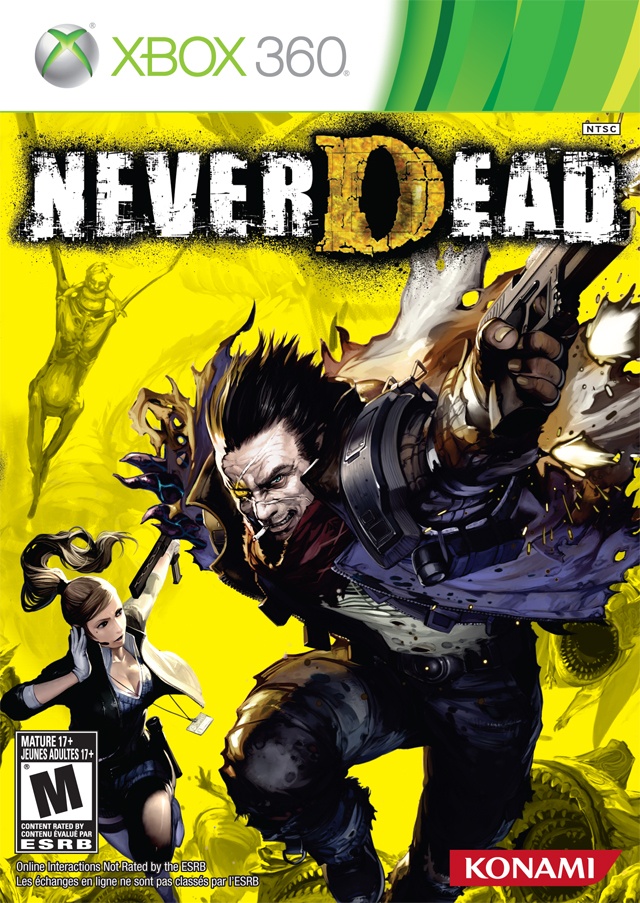
Review: Never Dead

Pros: Interesting take on the action game with a character that can’t be killed.

Cons: Predictable plot and game play that starts off strong but lacks variety.

Final Judgement: If you’re a fan of Japanese Action games then it’s worth the investment, but there are far better titles available that will scratch this genres itch.


Available for: PS3, XBox

God bless Japanese Action games. So predictable, so black and white, so completely fuck off bat shit insane you can’t help but smile. They’re like that socially awkward friend of yours that always ends up making statements that can only be described as the verbal equivalent of a loud fart in a quiet room.  You play Japanese Action games because they’re fun, campy and over the top.  Unfortunately, they’re also the personification of the developer's sexual frustrations as evidenced by over sexualized women flashing their ta-ta’s around while you awkwardly try to explain to your wife that you’re playing for the game play and not the booty. God fucking damnit, I hate you Bayonetta.
The worst part is, the game play in Bayonetta is actually very, very good
Never Dead, is a gong show of a Japanese Action game, brought to us by Rebellion and Konami, which fits the stereo type very well. Never Dead incorporates the tried and true Japanese Action Game formula of doing battle with various horrors from the beyond while engaged in retina detaching gun battles and sword fights. The game then attempts to spice it up with a fairly nut bar game mechanic in which  you get to give Monty Python’s Black Knight a run for his money. In Never Dead you don’t take damage you just get your  limbs lopped off and continue fighting on until your reduced to just your noodle, rolling about,  chasing down  your various bits which are now strewn willy-nilly about the room.   While this dismemberment wonderland of a game starts off enjoyable and original, the shiny new penny luster of Never Dead quickly fades and the game turns into a death march of one generic monster encounter to the next. In addition Never Dead also features one of the most awkward melee control systems I’ve ever encountered. Well get to all that in due course but first I want to bring you up to speed on the Shakespeare quality plot line of this diddy of a game.

"What ho! Have at thee! En gaurd! Truth and Justice! Pip-Pip, tea and crumpets!"
In Never Dead you play as Demon Hunter / Tortured Alcoholic / Adventure in Alliteration Bryce Boltzman. Heir Boltzman is a 500 year old career douche bag who started out as a total ponce, the type that would make Snow from Final Fantasy proud. Bryce tried to take down the “Demon King” Astaroth with his wife Cypher who had the ability to make demons vulnerable to injury and death – which kinda made her big deal. During the battle Boltzman more or less fucks the dogs and crafts soliloquies about truth and justice instead of laying boot to Demon ass, as a result Cypher ends up getting a discount chest piercing courtesy of the demon king. To add insult to injury Bryce is “cursed” by the demon king to be immortal, and unable to die. Now I say “cursed” with quotation marks, because I think the Demon King requires instruction on what a curse consists of as normally getting cursed sucks balls, kinda like being forced to eternally relive the disappointment at the end of Mass Effect 3, that is a curse, but being made immortal? That actually sounds awesome, so maybe the demon king is an ok dude. 

Bryce post immortal eye ball implantation... significantly less metro.

The game begins five hundred years after the death of Cypher and Bryce has evolved from a ponse douche to a surly bastard who doesn’t care about much beyond the bottom of his drink. Bryce now works for The National Anti-Demon Agency or NADA (tee-hee) with his partner Arcadia Maximille, a responsible mortal and sexual tension provider. Boltzman and Maximille have a love hate relationship, where Boltzman leers at Maximille and she shoots him in the face.  Now I get that he can’t die but simmer down already, maybe if you wore proper business attire you would get more respect.  Then again for a woman in a Japanese action game she more or less dressed like a nun.

If you don't think this is appropriate work atire for hunting Demons, google Ada Wong from Resident Evil.

The game follows the two as they investigate an increase in Demon Activity which unsurprisingly results in a second show down between Bryce and the Demon King who is attempting to get himself resurrected. You know the demon king, who we were led to believe was immortal and who wasn’t actually killed or even badly wounded by Boltzman 500 years ago? You may be asking  “If Bryce never killed him, why does he need to be resurrected?” to which the game replies, “Don’t worry about it ok? He just does, why you gotta ask so many questions?” 
Plot hole that you can drive a burning fertilizer truck through aside; the story of Never Dead is cookie cutter, the ‘plot twists’ are seen coming from a mile away and the story is incredibly linear. If you’ve played Devil May Cry or Gungrave then you’ve more or less experienced what the story of Never Dead has to offer. It’s instantly forgettable, however, as a saving grace the game doesn’t take its self too seriously.  It spices itself up with decently delivered slapstick and dialogue based humor which helps to smooth over the rough edges of the “story by the numbers” plot.
Where Never Dead attempts to set its self apart is in the game mechanics department.  The game has essentially two unique game play mechanics, the first is an analog stick based melee attack system the second is the aforementioned dismemberment system.

The analog stick attack system breaks down like this: To swing Bryce’s sword and attack you have to hold the attack button and move the analog stick in the direction you want Bryce to swing. You must then move the stick in the opposite direction to swing it again doing this in a deliberate manner allowed you to chain attacks together and make each swing more powerful. Sounds simple enough, but I found this very awkward in practice and I had a lot of trouble chaining attacks together. I found that busting out the blade always made for a frantic analog stick swirling episode as I tried to fend off a mob. I would have preferred to see a much simpler attack system.

Swing! SWING DAMN YOU!
The second mechanic, the dismemberment system comes to us by the way of Bryce being immortal. In the game this translates into Bryce not losing life points or health when damaged but instead losing limbs. Interestingly enough you can lose any combination of limbs and still be able to fight fairly well, even when you’re reduced to a severed head bouncing and rolling around the environment you still have a charge up attack that you can use to defend yourself. I gotta say, this is pretty cool, even as a head you can still fuck shit up and ruin a demons day.
...Or you can use it to shoot a few hoops.
Aside from being dismembered from battle damage, you can also choose to rip yourself limb from limb which can then be used to bait enemies or complete puzzles, for example throwing your arm into a fuse box to complete a circuit. As an added challenge as you lose limbs and your head, a particular enemy known as a Grand Baby will continually spawn and lurk around gobbling up your errant limbs and attempting to devour your vulnerable head.

"EAT ARM FLAVORED JUSTICE!"

Overall the dismemberment game mechanic is novel and unique enough to keep you interested for the lion’s share of the games relatively short play time. I will say though, that dismemberment is relied upon so heavily in the game that by the last two or three stages, it had worn its self out and this is where I have the biggest beef with Never Dead.
There is no real variation to game play; every encounter revolves around you destroying waves of demons while protecting Arcadia who can be killed and keeping track of your limbs that repeatedly fly off in random directions. Every encounter starts off fairly straight forward and adds different demon types until you`re just a head getting soccer kicked about the room. Eventually you land away from the mob and you have a small window to regroup and turn the tide.

This especially becomes an exercise in aggravation in the final battle where Bryce’s limbs appear to be held on by wet noodles as he constantly flies apart at the drop of a hat. The battles only challenge is trying to get yourself back together in time to do a sliver of damage during the Demon Kings short vulnerable phase. The only reason I stuck the game out is because I could feel that I was basically at the end of the game, there is really only so many times you can do the same thing in slightly different settings before you stop caring.

Yeah, yeah... shoot demons, protect Arcadia, pick up severed legs... fuck, whatever.
If you judge Never Dead solely on its value as an action game, it’s not the worst game you’ll ever play by far, aside from the awkward melee attack system the controls are tight and the dismemberment system is original and an interesting change of pace. However the cookie cutter story line and noted lack of variation in level design and battles really hurts the games over all enjoyment. I wouldn’t recommend this game for the casual gamer given the far better titles available in this genre such as Devil May Cry, but for those who are looking for a different experience, all be it one that is repeated ad nauseum, Never Dead isn’t a bad option.

Monday, 26 March 2012

Review: Mass Effect 3

Pros: Exciting combat, engaging characters, epic and original story line.

Cons: Confusing and unfulfilling ending, overly simplified exploration system.

Final Judgement:  If you’ve played the previous titles, you don’t need my two cents to decide to play this game.  Even with the ending, Mass Effect 3 is still one of the best games I’ve played.


Available For: PS3, Xbox, PC

Holy Fuck, look out god damn it, its Mass Effect 3! Where or where do I even begin with this title? To pretend that I wasn’t stupid excited to get my mits on this game would be like saying Captain Picard enjoys his tea lukewarm. It’s rare that I get this excited about the release of a title. Oh sure, I look forward to the release of lots of games… X-Com, Bio Shock:Infinite, Halo 4 just to name a few that are coming up. But when Mass Effect 3 showed up at my door three days before its estimated delivery date... I may have pee’d a little. Mass Effect has always been exactly what I look for in a good video game. A great story with well thought out memorable characters that you actually find yourself giving a damn about. A game that tells truly epic space opera that we really haven’t had seen since Battlestar Galactica. Add to that a level of character customization that not only lets you play a hero that looks like you but lets you play anything from a complete fucking bad ass tearing through the universe to a  granola munching kumbaya singing nice guy… or ya know, anything in between.
As I said... or anything in between, seriously what is Shepard doing here?
And so here we come to it, the final chapter in what some are calling “The Reaper War” Saga.  In the lead-up to this title Bio Ware played up the idea that those players who carried forward their characters through the first two games would be able to see the total sum of their decisions in the final show down with the Reapers.  The accumulation of their consequences or actions the mass of the effect on their… oh I get it now, clever. While Bio Ware does a superb job on this third game they fall short in the final fifteen or so minutes of the game. Sorry I should rephrase, it doesn’t just “fall short” it falls face first through a plate glass window in to a pit full of vinegar salt and barb wire.  However, let’s look past this minor faux pas for the moment as thinking about it too much makes me grow despondent and I start staring longingly out the window and singing Usher.  So I’ll come back to it at the end of the review after I’ve thought about all the good times I had.
"We had some good times running around the galaxy didn't we EDI?"
"We Sure did Jeffy, we suuuuure did."
For those new to this series the big thing you need to know about Mass is that there is a continuous story line between the games, a story line that is by in large determined by your decisions as the player. What this means is that two peoples play through of the Mass Effect trilogy will look grossly different depending on how they chose to play the game.  The continuous story line makes for a richer gaming experience then you normally find in story driven games and I would say it’s the Tao of Mass Effect.  Without it you basically have Gears of War with less steroids and characters that didn’t get personality cues from an Ed Hardy commercial.  If you haven’t played the previous two titles do yourself a huge favor, go download or pick up the previous two and play them through sequentially, importing your character. If you don’t you can still enjoy Mass Effect 3 for what it is but you will miss out on all the extra content and tailored encounters that the game affords you for playing the trilogy cover to cover.
Extra content, like sexing up your helmeted alien friend here.
Now, for those of you who have played the previous two titles, there isn’t a lot that has changed from the Mass Effect 2 as far as gameplay is concerned.  The combat system from Mass Effect 2 was one of the best things the developers  did for the series and luckily they continued the same style through to Mass Effects 3.  The primary action and story of the game unfold through third peron, cover based shooting missions, in these missions you select two squad mates from your team to accompany you, which again adds some uniqueness as each squad mate has their own unique reactions to events and conversations that they will have with Shepard and with each other as the mission unfolds adding to the replay value of the game. The other half of the game is an non-linear free roaming type game where you explore the galaxy, your ship and the Citadel (a giant space station which serves as the galactic capital). The combat scenes in each mission are exciting and well-paced.  It’s clear that Bio Ware has improved in the level design with levels and enemy encounters feeling more creative and varied.  The exploration segments however feel more simplified and dumbed down. There is now only one place for you to visit between missions, where in previous titles you could visit four or five areas.

The galactic exploration has also been dumbed down, allowing the player to simply fly around solar systems sending out radar pings and then being told if they found something or not. Now I know the exploration bit is something that by now I’m sure Bio Ware just feels it can’t win on. After all in Mass Effect 1 there was the totally awkward and time consuming vehicle segments in which you drove your six wheeled moon truck around what felt like a million planets trying to find… I dunno, your lost pocket change or some shit. This was considered one of the worst parts of the original Mass Effect.  In Mass Effect 2 they got rid of the moon truck and instead went with planetary scanning bits in which you had to systematically wave your scanning reticule over the surface of what felt like a million more planets in order to collect enough stuff that your crew didn’t die at the end of the game. This was also time consuming and considered the worst part of the second game. So I feel like in the third one Bio Ware just threw up their hands and said “Ok fuck it! Fine no more exploring! Just fly in circles and press a button, we’ll tell you when you get something! Happy?” To which my response is… well, no. Ok yeah, it was time consuming but at the same time it really made the galaxy feel like a galaxy. Now the galaxy feels unfinished and small.  There has to be a medium between painfully boring and stupidly simple, unfortunately I don’t know what that would be so I’ll just move on.
Ahh good times with the ol' Mako moon truck... Stupid truck.
The two biggest advents in Mass Effect 3 from the previous titles is the inclusion of Multi-player and voice commands via the Kinect system. Coincidentally these are also the two things that I was the most skeptical about in the lead up to the games release.
Multiplayer is a co-op game in which you and three other players team up using several different character classes and customizable models. There are five mulit-player maps which are introduced to you throughout the single player campaign. The missions are essentially twenty or so minute matches where you and your allies take on ten waves of enemies that progressively get more challenging. Interspersed throughout the ten waves are moments when you receive special mission objectives that you must complete within a time limit, such as killing off “targets of opportunity” or hacking a console (king of the hill style). Mass Effect 3 gives you an incentive to participate in Multi-player as every mission you complete adds to your “Galactic Readiness Rating” which is a measuring stick for how well your alliance will do against the Reapers in the final show down at the end of the Single Player Campaign. The multi-player was surprisingly fun, though I found participating in any of the missions above the “Bronze” challenge rating punishingly difficult. Even though it was repetitive the matches were often butt clenchingly pitched and exciting, particularly at the end of the tenth wave where you have to hold an area for extraction while your team gets totally mobbed by a seemingly endless horde of bogies. I really enjoyed the multiplayer aspect and it complemented the Single player game well.

YO JOE!
The Kinect commands were also an interesting addition.  The Kinect provided you with the ability to command your squad in combat by telling a squad member what to do for example “Tali, sabotage” or “Squad attack my target” you could also switch weapons and abilities by just saying the type of gun or ability you wanted to use instead of having to pause the action to bring up the ring menu. Out of combat  you can also use the Kinect to quick save, interact with devices and carry on conversations by saying the prompt for what you want Shepard to say next. I didn’t find voice command as useful in these sections as there was no real rush for me to issue a command. As well I found it awkward to be physically saying to a tv screen displaying an image of a person that doesn’t exist “Its good to see you again”  as opposed to just clicking on that selection on the conversation wheel and letting Shepard do the talking. The only real issue with the voice command was that  sometimes when characters were talking it would trigger the Kinect accidentally. There were a few times that a character would be talking to me while I was standing near a computer and they would say something that the Kinect registered as “Use” or “Examine” and suddenly I was purchasing a vacation home on Illium instead of paying attention to what floating jelly-fish man was trying to tell me. Ok on to the story line and in particular the ending… deep breath, Redcoat… you can do this…

Three games and I still can't tell which end their face is.
So… If this game is about fifty hours long, then the first forty-nine and a half hours of it are absolutely amazing. There are moments with incredibly well voice acted and masterfully directed dramatic sequences that had me on the edge of my seat. The introduction to the game, when the Reapersarrived on Earth and laid waste to Vancouver gave me goose bumps. As well one of the main villains in the story Kai Leng, is the type of villain that you just love to hate. He’s the type of douche bag that gets you invested in the game in that way that just makes you wanna keep playing so you can have a chance to really stick it to him.

Ahhh I wanna punch him right in his future goggle eye cover thingies.
All that being said however, the ending to this game was crushing, not because of the way it went down but because it was such a jarring departure from the rest of the trilogy. Minor spoilers ahead…

The game drummed into your head from the minute you started the first title that your decisions would have far reaching consequences and that there would be lasting repercussions to your actions. For the most part this held true, however, in the last scene of the game a decision is put to you where you faced with one of three decisions. A Decision that is available to you no matter what other decisions you made in the rest of the game. You may have saved the Krogan, you may have brokered peace between two bitter enemies, you may have saved a race from extinction because you felt they deserved a second chance, hell you may have helped an AI understand the human condition, but in the end, none of that mattered as all those choices go out the window for three equally unappealing outcomes. Door number one, door number two or door number three… make your choice. Oh and no matter which one you choose, it’s the end of galactic civilization as we know it.  

Now am I just upset because I wanted a happy ending where I got to live as the champion of the universe with my Quarian Girlfriend sipping mai-tai’s while people lavish me with adoration for saving all of creation? Sure that’d be nice, but it’s not required. I’m upset because it felt like all of my work, all the time I had invested into the trilogy didn’t matter. It felt like Bio Ware just didn’t try with the ending.  Like they had really good intentions but then just ran out of ideas or ways to make everything work together and  instead just banged out three similar endings to give the illusion of choice. It felt empty.
Now to the Mass Effect team, I appreciate what you did with this series, and you deserves definite props and plenty of applause for what you created. I would recommend this series to anyone in a heartbeat and still consider it one of my favorite games of all time, I just really wanted an ending that made me feel like I had beaten the odds and saved the universe.

In closing, I’m going to share a few links. Some have come up with well-articulated lists of reasons why the ending is a load of bullocks to which I will place a link to here.
Others have looked for deeper meaning in the ending and come up with a rather interesting theory which I will put here. If they’re right then boys and girls at Bio Ware are some of the craftiest mother fuckers who ever lived, but I think that this theory would just be coming a little bit too much out of left field for it to be true.  

Some people are so upset about it that they’ve started a group to lobby Bio Ware and EA to rewrite the ending and even raised afrightening amount of money for charity to support their cause. To that effect Dr. Ray Muzyka, the co-founder of Bio Ware has released this statement. Very interesting and makes for a very interesting commentary on the relationship between game designers and their consumers.
I’m interested to see what Bio Ware plans to do and will be watching this story closely, stay tuned to my twitter account and the review for updates.

Monday, 12 March 2012

Commentary - Syndicate: How a promising game jumped the plot line shark.

Note: I had intended to review Syndicate initially but found myself far to fixated on the plot line so decided to just go with a commentary on my views on the Syndicate plot. If you’re thinking about playing Syndicate it’s an overall well-designed game and will be appreciated by both the FPS and the science fiction crowd, just be prepared for a letdown in the story department.

I know in my reviews and in conversations about games I oft find myself harkening back to days gone by and games that I grew up with. Reminiscing about the days when the video game market wasn’t the bountiful cornucopia of treats that it is today. The original Syndicate, released in 1993, was one of these games and introduced me to the “cyber-punk” dystopian setting seen in such movies as Blade Runner and games like Shadowrun. For all its redundant game play, Syndicate was an enjoyable game. So when I learned Starbreeze Studios (makers of “Chronicles of Riddick: Escape from Butcher Bay”) had been green lit by EA to come up with a modernized version of this classic I was hopeful. After all if the game turned out to be anything like Riddick, we were in for a real treat. 
Unfortunately Starbreeze took a beautiful opportunity and sqandered it.  Instead of taking the opportunity to flesh out the skeletal storyline of a shadowy world run by faceless corporations who fuck the little guy and routinely commit atrocities, Starbreeze decided to mail in the ending of the storyline with a ho-hum predictable off the shelf story of betrayal and changing allegiances.

 As I said back in 1993 I played Syndicate for the first time and thoroughly enjoyed it, to the best of my recollection the story line of the game was this:
It’s the future, the world governments have been replaced by multinational corporations and the world is suffering from over population and pollution. You are some dude in a blimp that’s part of one of these groups. Your job is to take over the god damn world using a cybernetic squad of thugs whom you control. Oh and don’t worry about killing innocents or causing property damage because screw them you have a blimp, a cybernetic squad of thugs, and a multinational corporation backing you with more power than god almighty. Your squad thunders through the different territories killing, capturing and destroying the opposing syndicate’s resources until the world is covered with your corporate logo.
Blimps... because every evil dictator needs a mobile oppression platform.
The thing to take away from the 93’ version of Syndicate was that there were no “good guys” you and every corporation out there were complete ass holes and only concerned with profits and market share. In Syndicate, you were not a hero, in many ways you were the most vile and reprehensible villain. You were the Lex Luthor of the Legion of Doom.  Syndicate didn’t have a super deep or thought provoking plot, but its main theme, that the corporations were ruthless and all powerful shone clearly throughout the game.

So with a clear direction  from the original game and a talented studio like Starbreeze, the reboot of the series could only get better... right?

The modern Syndicate game places you as one of the individual cybernetic agents you previously controlled.  Removing the faceless squad based game play of the original. You play as Miles Kilo an Agent in the employ of Eurocorp, the largest and oldest Syndicate.  The game follows Kilo as he ruthlessly carries out the orders of Eurocorp which are piped directly into his brain via the “Dart 6 Chip” which is essentially a smartphone implanted in his head. The Dart Chip has a symbiotic relationship with Kilo and refers to itself and Kilo as “us” and “we”. The chip also routinely communicates with Eurocorp, seeking direction and revised objectives rather than allowing Kilo to make his own decisions. You as the player are never given an option as far as obeying orders are concerned you just do what the Dart Chip tells you to.
Dart Chip says: "SHOOT DUDES IN FACE!"
The first two thirds of the story are reminiscent of George Orwell’s 1984, with Kilo observing a world which is firmly in the control of Eurocorp. Those who have succumbed to the corporate will have been Dart Chipped and live in relative luxury. Those individuals who refuse to bend to the corporate will are cast into decrepit slums rampant with crime and disease. While playing you learn about this dystopian future from various documents and downloads that Kilo can collect.  As the game progresses this information paints a picture of a world suffering under the corporate superpowers.  The game is bleak and depressing.  At first, blush corporate life appears more or less utopian, but you quickly learn of the darker side with invasion of privacy, silent killings of dissenters, and filtering of the media to spin the corporate story.   The developers did well with the design of shiny steel and glass corporate towers where people are supposed to be living the ‘good life’ but upon closer inspection appear more like corporate prisons. 

Kilo carries out the corporation’s orders blasting through everything that gets in his way. Kilo never speaks or expresses his opinions on his predicaments or duties. He just moves around doing his job. Kilo never voices an opinion or even takes action to show that he has a personality which in the context of this game was appropriate for the protagonist. It added to the feeling that Kilo was nothing more than a manifestation of the corporations will. To me it didn’t matter what Kilo thought, because from the previous syndicate I was led to believe that Kilo doesn’t think. He cannot be reasoned with and he cannot be dissuaded by fear or personal feelings. Eurocorp points and Kilo obeys. Playing a blank silent character fit well with the dehumanizing theme of Syndicate where people are referred to as “soft assets” and the amount of trouble the corporations will go to protect their populations is directly linked to how much money they are worth.
IN THE FACE!
So the first two thirds of the game stay true to the original games theme: a world controlled by ruthless powerful corporations,  Any attempt to stand against them or get in their way is met with a response that involves guys like Kilo and high calibre firearms. Unfortunately Syndicate jumps the shark around the last portion of the game, with a fairly predictable twist likely intended to add depth to the Kilo character. 

The change in story line comes during the last segment of the game when the only true voice of descent against Eurocorp, a group of unchipped slum dwellers, has just been wiped out by Kilo alone.  While  The group represented a resistance that was only allowed to continue because it was so ineffective against the corporate power that it was below the corporations notice.  The mission ends with Kilo being injured while attempting to terminate a rebel sympathizer who was a scientist at Eurocorp. The scientist informs Kilo that she triggered a safety protocol in his Dart chip when he tried to kill her and he is now unable to injure her. As she turns to leave she tells Kilo that there is a human in him somewhere and that she hopes he finds it again someday. As a result of his injury, Kilo recovers memories of his childhood in which he learns that Eurocorp murdered his parents and kidnapped him at an early age because they deemed him to be genetically compatible to becoming an agent. To which I remarked, so what? Was this supposed to be a surprise? Did you miss the lion’s share of the game where Eurocorp demonstrated repeatedly that they were murdering dick holes who would sell their mothers eyes?
Young Kilo is taking this very well... after all he did just see his parents get shot, in the face. IN THE FACE!
So out of left field Starbreeze decides to shoe horn a personality into the up until now, silent more or less blank state of a character.  Apparently Kilo, who has been the pointy end of the aforementioned dick holes for his entire adult life, is surprised by the actions of Eurocorp.  He decides to change sides and fight alongside the rebel sympathizer through Eurocorp HQ to the CEO’s office while the building is being attacked by an opposing syndicate.

Kilo preforming brain surgery to steal the Dart Chip of a dude he shot. Why? Because Kilo and Eurocorp are dicks.
All of this just feels out of place and like two different plot lines got spiced together in post-production.  Aside from a single short cut scene where Kilo grabs the sides of his head and appears distressed after killing his former partner Kilo doesn’t do anything to show he has changed or even cares that his parents were killed by Eurocorp. Perhaps if they had from the beginning of the story shown that Kilo had a mind of his own or  reservations about his actions I might have been able to swallow this twist.  However,  as the game stands itfeels like Starbreeze never really knew where they were going with Syndicate and after painting themselves into a corner decided to wrap it up as quickly as possible.

"Ok Kilo, time to learn about your way tragic past and then spontaneously grow a personality, ready? GO!"
Personally, I would have preferred to see Syndicate go the other way and stay true to the 93’ versions roots. Kilo could have learned of his past and battled his way through the forces of the opposing syndicate to the CEO’s office only to have him turn and kill the sympathiser at the behest of the Dart chip and Eurocorp like the good corporate flunkey he is. Stay with the dehumanizing, depressing set up to the game and make the point that Kilo isn’t free, Kilo never was free because Kilo is an agent and an agent is an instrument of the corporation.

There is an adage in movies that says that if you drop the ball in the ending people’s perception of the whole movie will be tainted.  With previous games like Chronicles of Riddick under Starbreeze’s belt, I truly thought that this new Syndicate would easily be able to put forward a story that would do its predecessor proud and With the way that the first portion of Syndicate’s plot was playing out I thought I was going to have one of the top games of 2012 on my hands. Unfortunately the game concluded with an unsatisfying crash landing in predictability with an unconvincing change of heart. Syndicate had an opportunity to tell a thought provoking story that would strike chords with people and draw parallels with current events such as the greed that led to the global debt crisis, or at the very least given us a story that would make George Orwell proud. Sadly all we ended up with was a plot twist worthy of a Michael Bay film.

Monday, 27 February 2012

Reviews - Kingdoms of Amalur: Reckoning

Review - Kingdoms of Amalur: Reckoning

Pros: Rich and well written storyline, open ended game play style, lots of content to experience.

Cons: Nagging camera bugs and invisible walls are jarring to play experience.

Final Judgement: Not an instant classic, but a decent RPG that’s worth the purchase price.


Available for: Xbox, PS3, PC


Riddle me this! What does Todd McFarlane, R.A. Salvatore, Ken Rolston and Kurt Schilling have in common?  The likely answer at first glance, absolutely nothing. There is nothing that these four men have in common, they didn’t grow up in the same town, they didn’t all have the same stallion of a father and they don’t form up like Voltron and fight space monsters on weekends. They are, however all working at a game studio called 38 Studios, and are the creative team behind a new entry in RPG market Kingdoms of Amalur: Reckoning, a game which I am admittedly enjoying, although I have some nagging reservations.  Before we get into the review however, it occurs to me that a better question for me to lead with would have been: Do you know who Kurt Schilling, Todd McFarlane, R.A. Salvatore and Ken Rolston are? No? Well, let me tell you.

Ken Rolston is a game designer, one of the old school types that would appear in a Rat Pack-esque show if you were to gather together the so called “fathers of gaming”, you know the ones. The champions of years of pen and paper games gone by, working He has worked on such games as RuneQuest and Advanced Dungeons and Dragons. I can see it now, he’d be up there along with Gary Gygax , Bryan Ansell and that  math dudewho created Magic the Gathering. More recently Rolston is responsible for stealing days, if not weeks of your life as you trundled around Tamriel buying houses and picking herbs. That’s right, Rolston is the mad king behind Elder scrolls games Morrowind and Oblivion. For his retirement Rolston became the senior designer at 38 Studios and Lead Designer for Kingdoms.

Robert Anthony Salvatore, or R.A. Salvatore, as he likes to be called (I assume because it makes him sound more scholarly and sophisticated) is best known for his work on the Dungeons and Dragons “Forgotten Realms” campaign setting as well as the ubiquitous super hero/kind hearted rouge/brooding figure with a troubled past/walking argument for nature vs nurture guy Drizzt Do'Urden. Oh Drizzt, I can’t think of a single adolescent male who read the Ice Wind Dale trilogy and didn’t come away from it thinking Drizzt was the bees knees. I’ve got to give it to Salvatore, the man knows how to spin a good fantasy yarn. A skill which he brought to Studio 38 as the (and I can’t make this up) “Executive Creator of worlds” wow. Did Salvatore make up that title himself because that is creative. Anyway, in Kingdoms, Salvatore wrote all the story and dialogue.
So brooding and way awesome with his swords and shit, this guy is like elf batman.
Todd McFarlane, or Toddy-McF as he is called by no one, is not only a fellow Canuck but is also, according to my friends at Wikipedia, a “Comic Book Superstar”.  He has worked on a few small run comics… you know the type that nobody has ever heard of such as Batman, and Spider-man. M.C. F-Bomb is also the guy that created Spawn, the undead solider guy from hell sent back to earth to, I dunno, get revenge or something. T.G.I.McF. has a unique art style that is easily recognizable and defines the comics of the 90’s. He comes to Studio 38 as, you guessed it, executive art director. His fingerprints are all over the creatures you face in Kingdoms.

Finally, Kurt Shilling is the chairman of 38 studios.  A former major league baseball pitcher (links to Kenny Powers on standby) and by all accounts Shilling probably shoved dudes like McFarlane, Salvatore and Rolston into lockers back in high school. I’m not sure what Shilling’s contribution to Kingdoms is, I mean aside from him owning the studio, I don’t know what he contributed directly to Kingdoms. Unless there is a baseball mini-game I haven’t encountered yet. That being said at least I solved the mystery of the studios rather odd name, 38 was Shillings jersey number back in the glory days when everyone wanted a piece of his shit.

So now you know what it boils down to -  a proverbial super group of talent coming together to make a fantasy RPG the likes of which we have never seen. With this roster, I was fairly excited to give the game a whirl. Any who, after a solid twenty hours of game play and no end to the game in site I think I’ve seen enough that I can at least begin to review this game. Kingdoms has a lot of good in it, there is a lot that will bring a smile to the face of any RPG’er that being said, it also has nagging issues that won’t stop bothering me.  Rolston, Salvatore and McFarlane all do great jobs in their specific areas of design but I found that the good brought by the three is compartmentalized. The end result is a game that has some absolutely brilliant parts but overall lacks the consistency to make it a classic. As it is, it is fairly easy to see where their influences of Rolston, Salvatore and McFarlane begin and end. Let’s start off with Salvatore and the story:
Well written story and characters, yet as in all fantasy settings, less still equals more for females.
The story of Kingdoms of Alamur begins thusly: The Faelands region, where the game takes place, has been plunged into a war. A war that has been raging for years and pits the mortal races of the world against a powerful sect of the immortal Fae creatures known as the Tuatha Deohn, the Tuatha can die but they always come back to life reborn exactly as they were destined to be. This is a problem for mortals, because it’s tough to win a war when the bad guys just keep coming back progressively more pissed off at you because your spawn camping them. Which by the way, is a legitimate strategy.  The game begins with your character dying and being resurected in the well of souls, essentially a work around of death that the Gnomes came up with. Almost as soon as you begin to draw breath after resurrection, the Tuatha show up and destroy the well because immortality is their thing and they don`t like to share. You narrowly escape and in the process learn that as a by-product of your resurrection, your character no longer has a pre-determined destiny and that can now change the fate of others.

Now that’s some heavy stuff. Essentially you are an agent of change, an injection of chaos into an otherwise perfectly ordered universe where everyone’s life is pre-determined. By far, the best part of Kingdoms has to be the story and dialogue. Salvatore is a New York Times bestseller and shows us why with the Kingdoms story line. The story is engaging from the beginning and is well paced.  Even the side quests and optional faction quests are well written and engaging. My only question - what is with fantasy authors and the plight of immortal fae creatures?
He looks pissed off because now that he's seen you he needs to go throw himself off a cliff.
Fae also known as the fairy folk or fay folk seem to perpetually be in a state of decline whenever they rear their nature bound heads in any novel, show or video game. Think about it, movies like Hellboy, Lord of the Rings, Princess Mononoke and even fucking Fern Gully include Fae as a dying race. Every time mortals (ie humans) get anywhere near Fae they suddenly start falling apart, or running away or dying off. It makes me wonder if its symbolism for societies damage to the natural environment or just unoriginality on the part of the authors. It’s like a god damn literary rule like “I before E, except after C, or when sounded as A, like in neighbor or fey who must always be dying off when in close proximity to humanity.” This is the only place in the game where I felt Salvatore took the easy road out. As soon as I saw the first Fae in the game I thought: “I wonder how long it`ll be before they tell me that were killing them and destroying the forest?” The answer: About five minutes. Oh well, such is the way of Fantasy games I suppose.  

Speaking of fantasy games and people who know their way around them:
Rolston also plays to his strengths, several game mechanics from the Elder Scroll series crop up in Kingdoms (blacksmithing, collectable resources, houses to buy). In addition, Rolston also creates a destiny system for Kingdoms which can be selected and changed at any time to customize play style, much like in elder scrolls you decide your characters role organically as you play, not by selecting one of a handful of classes at character creation.  On innovation by Rolston is the “fate shift” game play mechanic, allows you to score huge experience bonuses by taking large groups of enemies to the edge of defeat before ending one of them off with a finishing move that would make Kratos proud. Well done Rolston, Fate shifting is way cool. There is nothing like finishing off a tough enemy in Kingdoms then by fate shifting them as a parting ‘fuck you’ because not only did you beat them, you just unmade them, they don’t even exist anymore once you’re done with them.

I like to imagine this was taken right in the middle of screaming "FUCK YOU DUDE!"
The gameplay in Kingdoms is solid; the combat is a lot more stylized and entertaining and plays more like an action game then what one would normally expect from an open ended RPG. Rolston also included a number of different skills, spells, abilities and attacks that your character can learn as you go along which keeps gameplay fresh. The experience is not without itsflaws however: Some places in the game suffer from invisible walls which are always jarring, and the enemy AI fluctuates from clever to lobotomized. Furthermore I found that the camera had an annoying tendency to clip through the ground if your character was engaged in combat on a slope. One second I’m watching a Brownie charging towards me down a hill the next all see is skybox. At least it’s a good looking Skybox, which is where McFarlane’s role in this comes in.

Look at these things! LOOK AT THEM!
McFarlane’s presence is definitely felt in the creatures and monsters you encounter as they have a classic monstrous flare to them that McFarlane is known for. Do bears need help looking ferocious? Toddy-boy thinks so, and the rats are downright terrifying, they’re like a cross between and Angler fish and leper. As well, much like in Spawn, there is blood… lots of blood, and impaling and tearing asunder. The Blood and violence which doesn’t really fit with the cartoonish fairy tale-esque setting that appears whimsical and definitely not the Hyperrealism that other RPG’s like Elder Scrolls try for.  Not that there is anything wrong with that. I actually like this art style when it comes to fantasy setting games.  It gives the game a  “Fable” like feel. As well, the varied and colourful setting compliments the rich fantasy story that Salvatore weaves.  

So, should you buy Kingdoms? If RPG’s are your thing, sure. Best RPG ever? No. Evidently it takes more than a boat load of big names to make an awesome game. Make no mistake, Kingdoms is definitely a good game, it’s a solid RPG and the talents of McFarlane, Salvatore and Rolston are definitely seen in the overall structure of the game. The action oriented style of the game is enjoyable and the world is colorful and fitting with the fantasy tone of the game. While some of the gameplay mechanics could definitely use polish, the excellent story and great dialogue will help to dull the sharp edges of some of the nagging gameplay issues. If you’re an RPG fan grab this title, you’ll get your money’s worth, and it won’t leave you disappointed.

Monday, 13 February 2012

Reviews: S.P.A.Z.

S.P.A.Z. (Space Pirates and Zombies)


Pros: A fun, value priced title that will bring back memories of classic games.


Cons: Repetitive game play and a lack of variety in content.


Final Judgement: SPAZ lives up to what it’s trying to be and will entertain most gamers, definitely worth the download price.


Available for: PC (Steam)


Does anyone remember the old Star Control series from the early 90's? Or more to the point its follow-up title Star Control II: The Ur-Quan Masters? That, my friends, was a game that was air tight and dipped in gold. Pull up a stump children, and let's rap about this for a minute. In this diddy of a game, you found yourself in a galaxy made up of hundreds of stars and planets. You were the captain of a ship that was completely customizable. Your job was to fly around this galaxy meeting aliens, building alliances, and forming an unstoppable armada of ships which often resembled the end result of an out crazying contest between Gene Rodenberry and Disney. All this so you could tear down an evil empire made up of evil squid like creatures who’ve enslaved the human race. Why did the evil octopi do this you ask? Because, once they were enslaved, and they didn’t like it very much and after emancipating themselves they figured they should try the whole Overseer gig. Now that I think of it, the plot of Star Control II actually makes a compelling argument for the whole “Learned behavior theory” in violence.

As I said... Out crazying contest.
Star Control was awesome. It was an excellent mix of role playing, resource management, and arcade action. The story was spiced with humor, the characters were original and the plot was entertaining. What’s more, though its graphics were simple, it was chalked full of content. Every system you explored had something unique about.  Whether it be mineral rich planets, earth like moons teaming with life or the colony of one of alien races populating the galaxy there were endless means to exploit them all. Star Control II just had plenty for you to do. Provided, of course, that your idea of a good time was exploiting the fuck out of everything you laid your eyes on. Come to think of it, in the Game you, the hero, use the fact that your race is enslaved as an excuse to exploit, lie and more or less weasel your fellow sentient races into destroying each other and dying at your whim. I gotta say, in retrospect, this game kinda goes to a dark place.

Although Bio Wares Mass Effect series comes close to replicating the feel of Star Control even making that comparison still feels like a stretch. Star Control was a completely unique experience. One that would only really work in the way it was originally presented - a 2D top down space fighter game. It’s unfortunate so few people that I talk to have ever heard of the game let alone played it. That being said I know of at least two brochachos that have not only heard of Star Control II but quit their day jobs and spent countless hours crafting a game that was a love letter to it. Two hombres who if they continue on their current path may prove to be for video games the next incarnation of the Buddha. Two pillars of digital justice who created the game which is the focus of this week’s review. Richard Clifford and Andrew Hume who created SPAZ or Space Pirates and Zombies.

Richard Clifford and Andrew Hume, two guys who worked together for several years at RadicalEntertainment.( the studio behind the Prototype series).  After working on two projects that were cancelled half way through development and seeing sixty of their co-workers and friends get laid off, the two decided that working for Radical and its cancel-happy ways was not for them. Their response? Stick it to the man by quitting and working for free from the dim and dank basements of their respective homes. The two decided that they wanted to take gaming back to its roots and to create a game that was in the same vein as Star Control and Master of Orion.

I have a lot of respect for these dudes, what they did took a lot of balls... So much so that here is a link to the slow clap from Cool Runnings to help underscore their achievement. Respect.


In SPAZ, you play as a Space Pirate in command of a cobbled together star ship called the Clockwork. The galaxy has been populated by humanity and most of our efforts as a species revolve around the mining of a special element known as "Rez". The goal of the game is to escort the Clockwork to the galactic core where rumors abound of a "Rez" mother lode. The only sticking point is that the Galaxy wide authority, known as the UTA, has closed down interstellar travel by blockading the various warp gates that connect star systems. The UTA's reasoning?   “To prevent the spread of interstellar sicknesses through careful inspection and stringent regulations.”  As you are a Space Pirate, your response to the UTA is a big Yo-Ho! And YARRR! as you mercilessly blast your way through the many blockades between you and the galactic core. Now as this game is called Space Pirates and Zombies, I suppose it is no surprise that as you wind your way towards the core you discover the interstellar sickness the UTA is concerned about containing is a parasitic alien that turns humans into brain munching Zombies and ships into Zombie carrying spores of doom. Zombie carrying spores of doom which quickly transition from being a novel distraction from blasting the UTA into “those fucking things that make every mission a hundred times more difficult then they need to be.”

The Clockwork just kinda floats around, it would be nice if it helped out a bit more often.

That is more or less the plot of the game. Some nifty features of SPAZ include a randomly generated galaxy that you define the size of as well as a plethora of ship designs which you pick up through the game. The ship designs have a number of slots and systems that can be customized and reconfigured which allow for a fair amount of experimentation and play. For example, I found myself playing around with various weapon configurations in an attempt to find the optimum mix that would allow me to burn through an enemy space stations shield while still having the armor piercing punch to crack its hull open.

The game play itself is fairly straight forward, you command a fleet of three ships. You personally pilot one of them while the other two are controlled by AI. You use your mouse to target and orient your ship and you use the "WASD" keys to control its Thrusters. Combat is an arcade slugfest where you basically trade fire until one ship explodes. There isn't a lot of strategy involved as the Space you do battle in is more or less devoid of any meaningful terrain. The combat in SPAZ doesn’t require a heck of a lot of thought, but that’s not such a bad thing. Sometimes you just want to blow shit up, not agonize over the details of how you're going to do it. More to the point however, the quick paced combat in SPAZ is fun, so who cares if it’s simple. 

As for the graphics in the game, MinMax did an excellent job of sprucing up the 2D style of play by adding 3D backgrounds and layers of space debris, clouds and other effects on to the 2D gameplay. The background is full of, planets, nebula, ship wrecks and space junk which adds eye candy polish to the presentation of the game.

Engaging in battle with the aforementioned fucking zombie ships.
For all of the good to be found in SPAZ, after a few hours of play players are likely going to start feeling that the title lacks variety. At this point players will have seen everything that SPAZ has to offer. Every mission in the game involves blowing up enemy ships. Enemy ships which are all the exact same design as ships that you have access to. Aside from the Zombies, which only appear in the last third of the game, the only other things you encounter that you can meaningfully interact with are the two factions: The Civilians and The UTA. Both factions are in every system and more or less fly the same ships. The only change from star system to star system is the randomly generated relationship level of the two factions in relation to you. I would have liked to see a bit more variety; maybe some missions where you need to assist with research or transport items between systems or maybe a couple of more factions such as Pirates and local governments. As it is, the SPAZ galaxy feels a bit empty and incomplete. Yes you have a giant and nearly endless galaxy to explore, but when it’s all the same, why would you want to?    

And they will all look almost exactly the same.
To be fair, Hume and Clifford acknowledge this short coming in SPAZ and have even said that they had wanted to include four factions and more types of ships but as the game grew in complexity and the release date got pushed back they were unable to add in all the content they had originally intended. Given the nature of how SPAZ was developed. I have to say I can’t be too upset with their decision to release the game without all the brainstormed content.

I picked up SPAZ off of steam on sale for four bucks and it gave me a good few days’ worth of nostalgic game play. When I last checked its regular price was ten dollars. I can guarantee you that even at twenty dollars SPAZ would be a good investment of your time and money. Yes it lacks variety, but it makes up for it with its simplistic charm and fun, fast paced arcade style.

In closing I would also like to mention that while I was researching for this article, I came across a website entitled “The Ur-Quan Masters”. A port of Star Control II which was developed by a group of guys who had gotten together to re-master and re-release the original game which I believe is now considered abandon-ware. It’s ready to go and it’s completely free! Check it out and let the good times roll.